
Keyboard Shortcuts?f

×
  • →Next step
  • ←Previous step
  • ↓Skip this slide
  • ↑Previous slide
  • mShow slide thumbnails
  • tShow transcript (+SHIFT = all transcript)
  • nShow notes (+SHIFT = all notes)

Please be cautious in using the transcripts.

They were created mechanically and have mostly not been checked or revised.

Here is how they were created:

  1. live lecture recorded;
  2. machine transcription of live recording;
  3. ask LLM to clean up transcript, and link to individual slides.

This is an error-prone process.

Click here and press the right key for the next slide.

(This may not work on mobile or ipad. You can try using chrome or firefox, but even that may fail. Sorry.)

also ...

Press the left key to go backwards (or swipe right)

Press n to toggle whether notes are shown (or add '?notes' to the url before the #)

Press m or double tap to slide thumbnails (menu)

Press ? at any time to show the keyboard shortcuts


Intro

insert-transcript#222002a6-9ea6-490b-aa03-fd9152eef005-here

INTERFACES

---

[email protected]

[email protected]

tinyurl.com/5cc64hjk

insert-transcript#c72e63f7-8725-43b2-a342-12c4617fa0c4-here
The broken escalatorA person walks towards a stationary escalator in three steps. On the second step the thought “It’s stopped.” appears. On the third he steps onto the first step with an exaggerated forward lean. A stopped-escalator sign marks the cause. A tiny black-hat observer on the landing is a tribute to xkcd. Dashed arrows are optional movement expectations, not actual escalator motion.It’s stopped.It’s stopped.It’s stopped.ESCALATORSTOPPED?

based on Reynolds & Bronstein (2003)

intention and knowledge sometimes fail to match what is represented motorically

intention and knowledge are not inferentially integrated with motor representation

insert-transcript#a559d460-4464-492c-bb4c-0c96e5dcf2b5-here
insert-transcript#02342225-6af7-4358-bda4-500cb5539827-here

two kinds of state are inferentially integrated:

in the absence of obstacles
such as time pressure, distraction, motivations to be irrational, self-deception or exhaustion,

any states of these kinds can jointly feature in a single process
of inference or practical reasoning

in such a way that
arbitrary rational relations between their contents
appropriately influence how the process unfolds.

insert-transcript#97082b18-efac-4947-ade4-78791d11687a-here

two responses

it’s not a real problem

it’s real but your solution is wrong

insert-transcript#aaae0206-4ca5-42b7-b3c9-7be919af0d7d-here

interface problemS

primary motivational states vs desires
(Dickinson & Balleine, 1994)

precise number representations vs analog magnitudes
(Odic, Le Corre, & Halberda, 2015; Ebersbach & Erz, 2014)

ant navigation: path integration vs visual landmarks
(Buehlmann, Mangan, & Graham, 2020)

owls: auditory vs visual cues to location
(Knudsen, 2002)

...

insert-transcript#196a397e-1429-4740-8c8f-30565dda07e0-here

interface problems with artifacts

flight controllers: radar vs flight strips
(Durso, Batsakes, Crutchfield, Braden, & Manning, 2004)

astronomy: radio vs optical measurements
(Fan, Budavári, Norris, & Basu, 2020)

music: sheet vs audio
(Dannenberg & Raphael, 2006)

...

insert-transcript#668b1068-130d-4c8d-a019-11c1a6d2cca6-here

Why are interface problems pervasive? Why not just inferentially integrate?

costs of inferential integration:

- design complexity [long term]

- greater risk of error [immediate]

‘Often the performance of a data fusion system [...] is below that of the individual sensors. This phenomena is known as catastrophic fusion’

(Mitchell, 2026, p. 11).

insert-transcript#fa46987d-afb2-4b74-8f2c-6ac344898f64-here

aside: representational format


the interface problem ‘is framed by [...] assumptions [including] that intentions are propositionally formatted, whereas motor representations are not

[...]

this understanding of the interface may need replacement. Arguably there are several interfaces within motor representation (and indeed, cognition)’

(Mylopoulos, Pacherie, & Shepherd, 2025, p. §7)

insert-transcript#26b19ac2-a5ba-47bc-b29a-ae994c21e394-here

two responses

it’s not a real problem

it’s real but your solution is wrong

insert-transcript#c432ce43-d3fa-4601-9238-ddd101d23279-here
Reference by deferenceA deferential action concept may be acquired through experiences of acting or imagining acting that depend on motor representation. The concept refers to an action outcome by deferring to motor representation and can later figure in intentions. The final red dashed line, a critical extension rather than a claim of the original proposal, asks whether fixing the concept's reference explains non-accidental matching on each occasion of use.intentionmotor representationtranslation?action outcomegrasping / releasingthe mug’s handlerepresentsexperience of acting /imagining actingshapes experiencedeferentialaction conceptenables acquisitiondeferencerefers tolater usematching !?!

objections to reference by deference

insert-transcript#fa78352f-2680-4a09-82a0-672a4c06009a-here

objections to reference by deference

misfire

‘unclear what it would be for such a demonstrative to misfire, i.e., to “point” to the wrong motor representation’.

selection

‘the agent must have an independent grasp of which motor representation is the appropriate one to select via such deferral. But this would require a way of translating between the intention and the motor representation’.

awareness

motor representations ‘are subpersonal states that are inaccessible to awareness’

Mylopoulos & Pacherie (2016, p. §4)

ooof!

insert-transcript#4cebc192-883f-41bd-83f5-9ddacdc9daea-here

simple objection

fixing reference demonstratively does not explain matching

insert-transcript#343d5905-5d54-4c2a-bc95-6e34cdeb442f-here
Reference by deferenceA deferential action concept may be acquired through experiences of acting or imagining acting that depend on motor representation. The concept refers to an action outcome by deferring to motor representation and can later figure in intentions. The final red dashed line, a critical extension rather than a claim of the original proposal, asks whether fixing the concept's reference explains non-accidental matching on each occasion of use.intentionmotor representationtranslation?action outcomegrasping / releasingthe mug’s handlerepresentsexperience of acting /imagining actingshapes experiencedeferentialaction conceptenables acquisitiondeferencerefers tolater usematching !?!
insert-transcript#24851a37-2730-45fc-8806-5415cdf5c8f1-here

observational vs executable action concept
(Pacherie, 2011, p. §3)

executable action concepts are linked to motor schemas
(Mylopoulos & Pacherie, 2016, p. §5)

deployment ‘serves as a pointer to a where appropriate motor schemas ... are stored’
(Mylopoulos, 2022, p. 288)

concepts are pointers
(Shea, 2024)

structured action representations
(Pacherie & Mylopoulos, 2021, p. §§4–6)

dilemma

is the concept’s content fixed independently of the motor schema it points to?

if yes:
how do they every non-accidentally match?

if no:
looks like deference again (?)

compare: Shepherd (2019); Levy (2025, p. §2.3); Ferretti & Caiani (2019, p. §3)

insert-transcript#db75b6e6-48f8-45c7-a6d9-dffc55111a89-here

back to 2000 ...

insert-transcript#c4e07387-d401-4080-9a8e-5096fd9df06d-here

‘basic action concepts are demonstrative concepts.

To have the concept of a basic action is to have a concept of acting ‘thus’,

where ‘thus’ denotes a property made accessible to the agent by the motor representations he is able to form.’

(Pacherie, 2000, p. 425)

insert-transcript#7d23e1f7-19be-49c0-9f60-3e8d926e67d5-here

case study

Humans can

intentionally produce words

years before they can

act on phone-structured intentions successfully.

ex: add [p] to [ˈɔzɐ]
(Morais, Cary, Alegria, & Bertelson, 1979)

insert-transcript#47adf3d4-0174-40f6-aa58-c5fe93c08cbd-here
Motor organisation and intention in speech developmentA broken time axis, months then years. Above the axis: categorical perception, articulator restraint affecting discrimination, babbling, and phone-sized motor representations at 4–5 years. Below: intentions concerning words from about one year, rhymes and syllables, and intentions to add a phone at 6–7 years; illiterate adults mostly fail non-word tasks. A red dashed link marks the interface problem between phone-sized motor representations and phone-structured intentions.1–467–9~1~34–56–7adultsmonthsyearscategoricalperceptionrestrain tongue:discriminationimpairedbabblingba, daphone-sizedmotor representations(adaptation transfers)intendwordsrhymes,syllablesintend: add a phoneosa → posailliterate adults:19% on non-wordsinterfaceproblemyears apart

Eimas, Siqueland, Jusczyk, & Vigorito (1971); Bruderer, Danielson, Kandhadai, & Werker (2015); Caudrelier et al. (2019); Morais et al. (1979)

insert-transcript#3c00c58d-304a-4181-a2a4-e75e1828c46c-here
1–4mosearly catgeorical perception
(Eimas et al., 1971)
~5mosadjust vocalization toward vowel
(Kuhl & Meltzoff, 1996)
6mosrestricting relevant articulators impairs consonant discrimination
(Bruderer et al., 2015; Choi, Bruderer, & Werker, 2019)
7–9mosbabbling *ba*, *da*, ...
(Kuhl & Meltzoff, 1996)
~36moswords, sentences, conversations
~4yrsrhyming games, limited phonological awareness
(Carroll, Snowling, Hulme, & Stevenson, 2003)
~5yrssegment into syllables
(Liberman et al., 1974)
by ~7yrsblend and segment phones
(Chafouleas, Lewandowski, Smith, & Blachman, 1997)
onset mathcing (day → dark or park?)
(Cheung, Chen, Lai, Wong, & Hills, 2001)
phone deletion (e.g. *rice* minus /r/ = *ice*)
(Høien, Lundberg, Stanovich, & Bjaalid, 1995)
phone substitution (/g/ → /n/ in *go* = *no*)
(Carroll et al., 2003; Chafouleas et al., 1997)
insert-transcript#c5596190-0677-4e54-b6ed-54d6c901b511-here

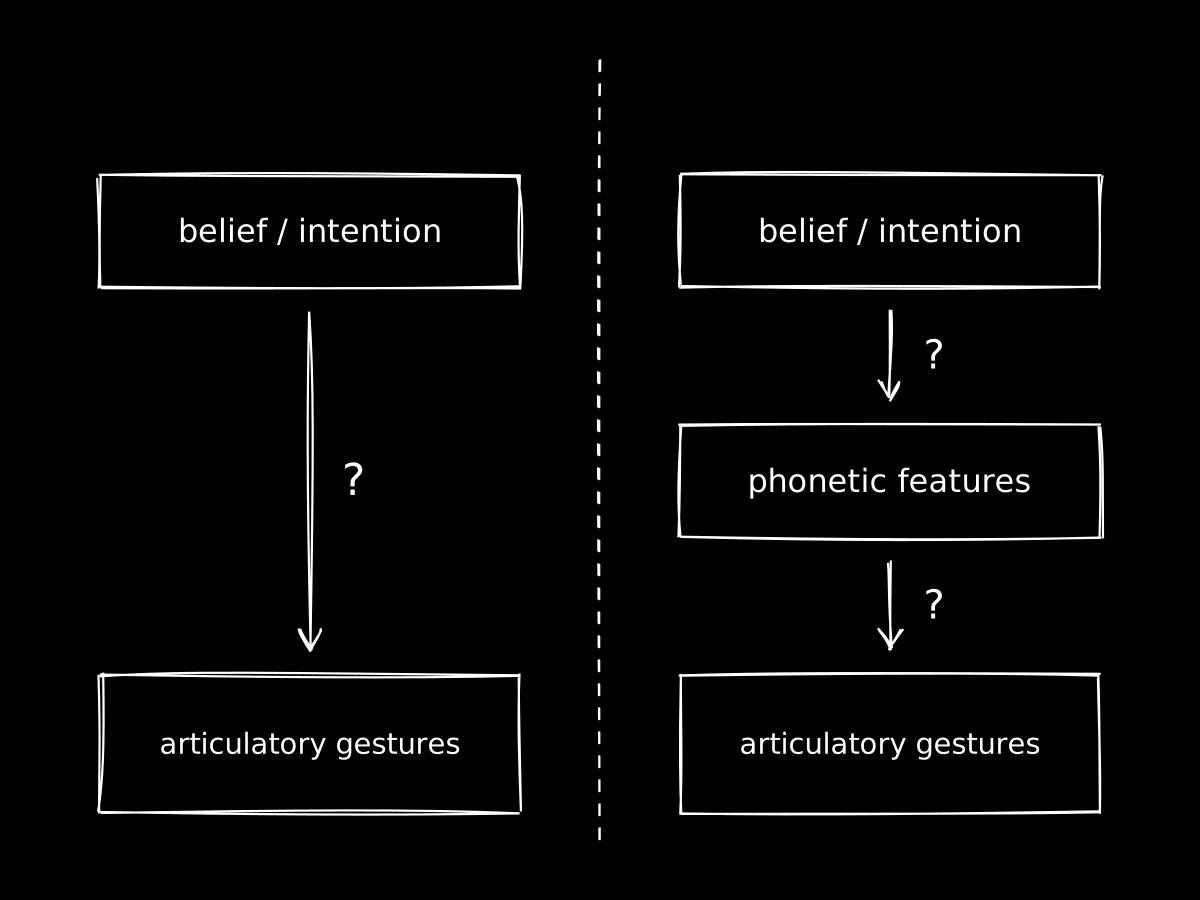
Two Interface Problems

from ~10-16 months on

belief/intention: word

matches (or not)

motor representation: word- or syllable-sized plan for articulatory gestures

after phonological awareness (≥5 years*)

belief/intention: phone-structured action

matches (or not)

motor representation: phone-sized components of plan for articulatory gestures

insert-transcript#5c78a97e-6e02-41cd-98f7-f49198ab044b-here
Two interface problems in speechLeft: an intention to say the non-word osa must match a whole word-sized gestural score. Right: an intention to add [p] to osa still matches the whole score, but must also match just the gestures for [p], a lip closure and a glottal opening. Gestural scores are schematic, not measurements.intend: say ‘osa’?lipstongue tipglottis[ˈɔzɐ]intend: add [p] to ‘osa’?lipstongue tipglottis[ˈpɔzɐ][p] = lip closure + glottal opening
insert-transcript#e7ed631a-1272-47d4-9189-558004e0f38e-here

background

insert-transcript#079f0174-cf30-49e7-8e46-622652edc901-here

adaptation at phoneme level
(peturbed auditory feedback for /e/)
-> have phone-structured motor representations

but

little or no phonological awareness

in 4-5 year old pre-schoolers

(Caudrelier et al., 2019)

insert-transcript#ee9b2f4e-c0a3-4fcf-82fb-20f2083ed85f-here

‘in NW [non-words] trials, the experimenter uttered a non-word which would become another non-word, for instance "osa" became "posa", "chosa" or "mosa" depending on phone condition.’

(Morais et al., 1979, p. 326)
insert-transcript#1a1767b5-399d-439e-a7ac-4d66cd7f8a2b-here

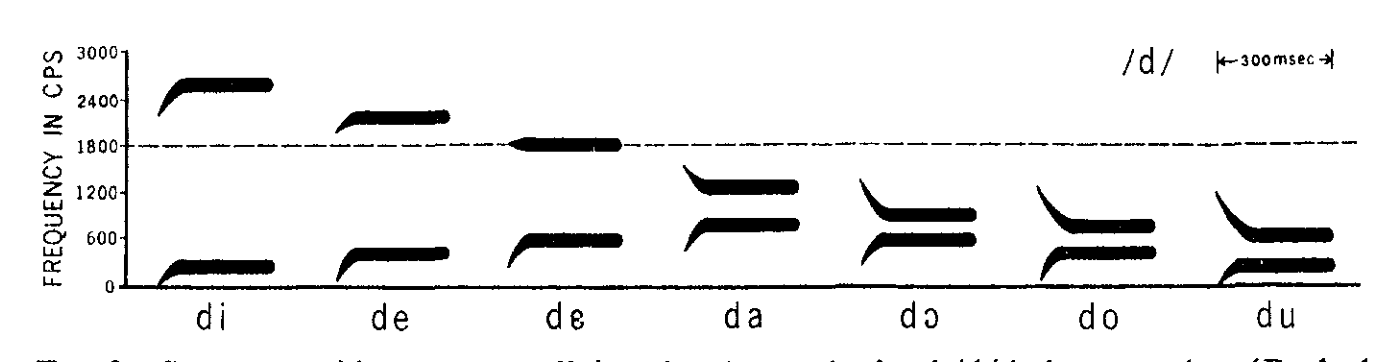
(A. M. Liberman, Cooper, Shankweiler, & Studdert-Kennedy, 1967, p. fig.~2)

insert-transcript#995cf659-de4f-474e-98a1-37e85f4cdc4a-here

no acoustic criterion for dividing the sound into phones

‘the segmentation of the acoustic signal does not correspond directly or in any easily determined way to the segmentation at the phonemic level.

[...]

In bat, for example, the initial and final consonants are, in the conversion to sound, folded into the medial vowel, with the result that information about successive segments is transmitted more or less simultaneously on the same parts of the sound’

(I. Y. Liberman et al., 1974, p. 203)

insert-transcript#35c4b381-4897-4fea-8f85-e8e3cf39d305-here
Phones, sound and gestures in “bat”Top: three phones, [b], [æ] and [t]. Middle: a single continuous acoustic segment in which information about [b] and about [t] overlaps the vowel, so there is no place to cut out a phone. Bottom: overlapping articulatory gestures, a lip closure, a tongue-body vowel gesture and a tongue-tip closure. Schematic, after Liberman et al. 1974.phonessoundgestures[b][æ][t]information about [b]information about [t]one acoustic segmentcut here?lipstongue bodytongue tipclosurelow front vowelclosure

after I. Y. Liberman et al. (1974, p. 203)

insert-transcript#e6866dd1-3013-470c-95f1-7cfc3f6f6b15-here

articulatory getsure

example: closing the lips; constrict tongue tip
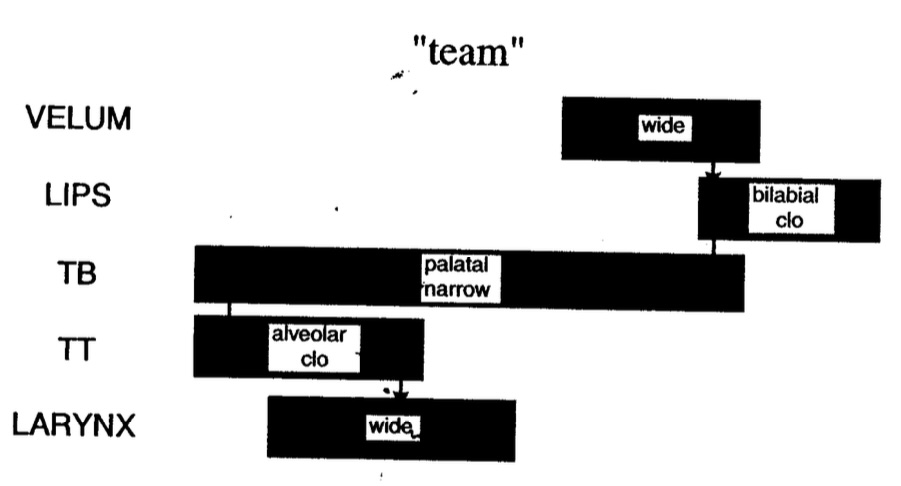
Goldstein & Fowler (2003, p. fig.~1)

insert-transcript#1be1cf81-b816-4a48-83d8-146ecb860984-here

lack of inferential integration
between motor representations and beliefs

most teachers cannot count the phones in ‘ox’
(Treiman & Cassar, 1997)

UK: [ɒ], [k], [s]

US: [ɑ], [k], [s]

btw: marks a limit of ‘mixed-format’ and ‘same-format’ views?

(Shepherd, 2019; Ferretti & Caiani, 2019)

insert-transcript#3d492b14-1bc4-434a-8c4d-e89de6db97db-here

One interface problem or two?

insert-transcript#98358ae3-06eb-44b0-ba63-56c06d4f76c4-here

interface problem

insert-transcript#a8303543-41e4-4d10-bc32-fefabbdc5978-here

Two Interface Problems

from ~10-16 months on

belief/intention: word

matches (or not)

motor representation: word- or syllable-sized plan for articulatory gestures

after phonological awareness (≥5 years*)

belief/intention: phone-structured action

matches (or not)

motor representation: phone-sized components of plan for articulatory gestures

insert-transcript#10c959b1-8bb2-45d4-8d6a-848dac7727bf-here

crude idea 1

merely linking motor representations to perceived phonetic contrasts is sufficient for matching
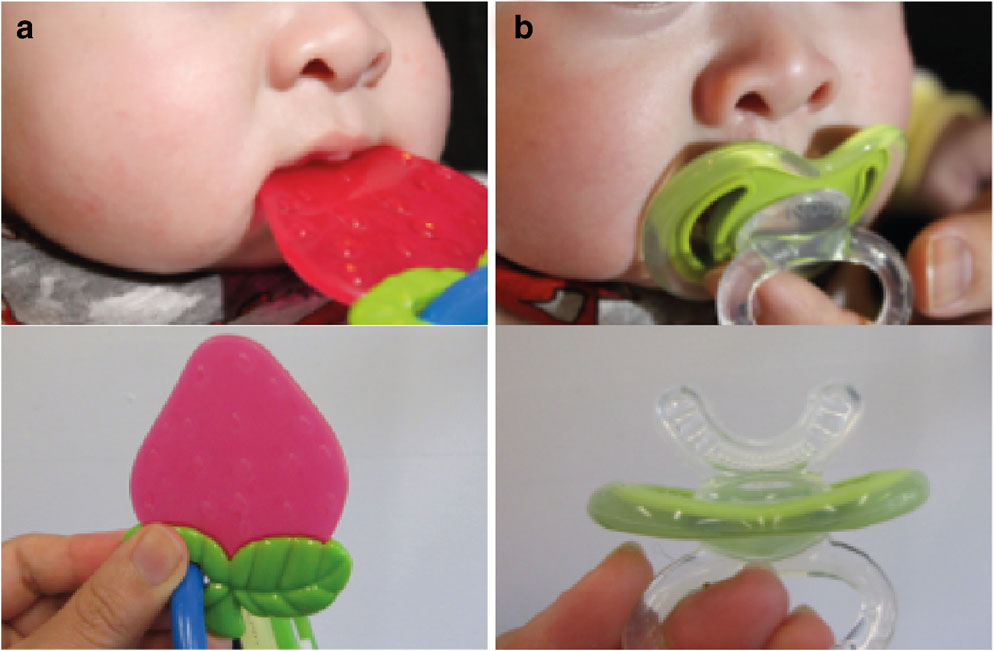
motivation: Krieger-Redwood, Gaskell, Lindsay, & Jefferies (2013)

---

objection

Some adults never acquire phonological awareness
(Morais et al., 1979)

But motor representations of articulatory gestures can influence perception of phonetic contrasts ... even in pre-literate people
(D’Ausilio et al., 2009; Smalle, Rogers, & Möttönen, 2015; Carneiro Pereira, Patri, & Vannuscorps, 2026)

insert-transcript#2d3247a6-2d1a-4013-8353-aec59c109081-here

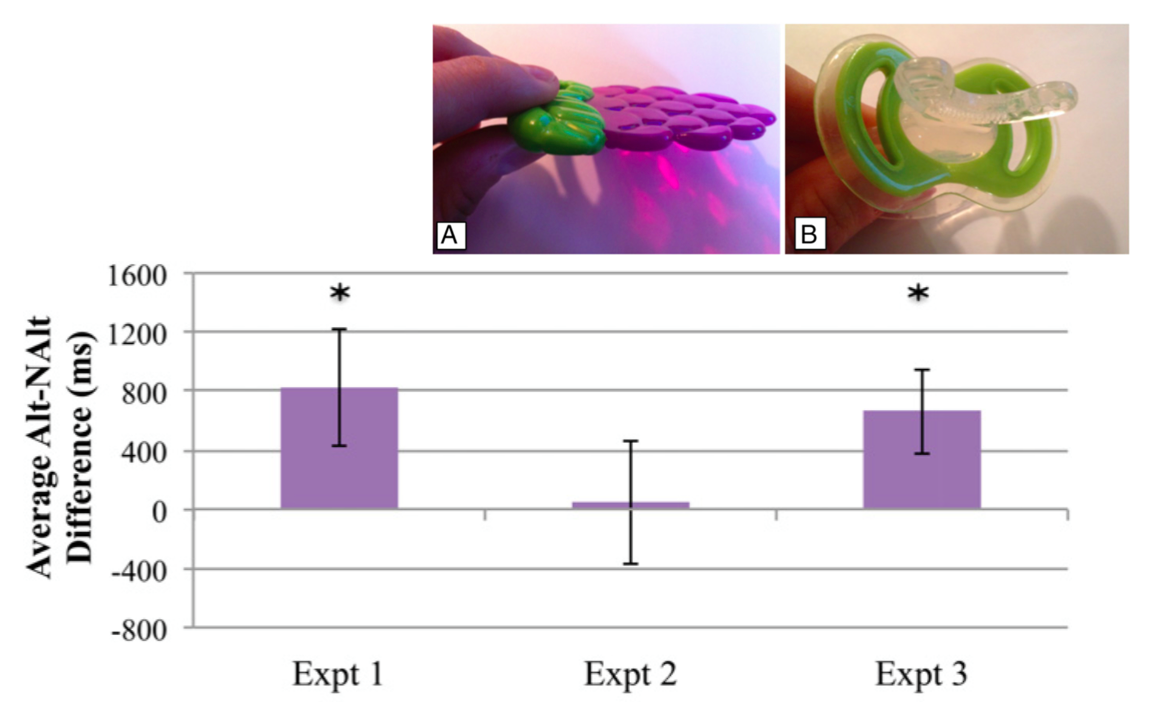
(Choi et al., 2019, p. fig.~1)

insert-transcript#6882d951-bf85-45cc-9a14-6abce78c226e-here

(Bruderer et al., 2015, p. fig.~5)

insert-transcript#0a68f0ab-64f3-4fbb-a07d-384dfc8d876c-here

crude idea 1

merely linking motor representations to perceived phonetic contrasts is sufficient for matching

motivation: Krieger-Redwood, Gaskell, Lindsay, & Jefferies (2013)

---

objection

Some adults never acquire phonological awareness
(Morais et al., 1979)

But motor representations of articulatory gestures can influence perception of phonetic contrasts ... even in pre-literate people
(D’Ausilio et al., 2009; Smalle, Rogers, & Möttönen, 2015; Carneiro Pereira, Patri, & Vannuscorps, 2026)

crude idea 2

linking letters to phones is what enables matching
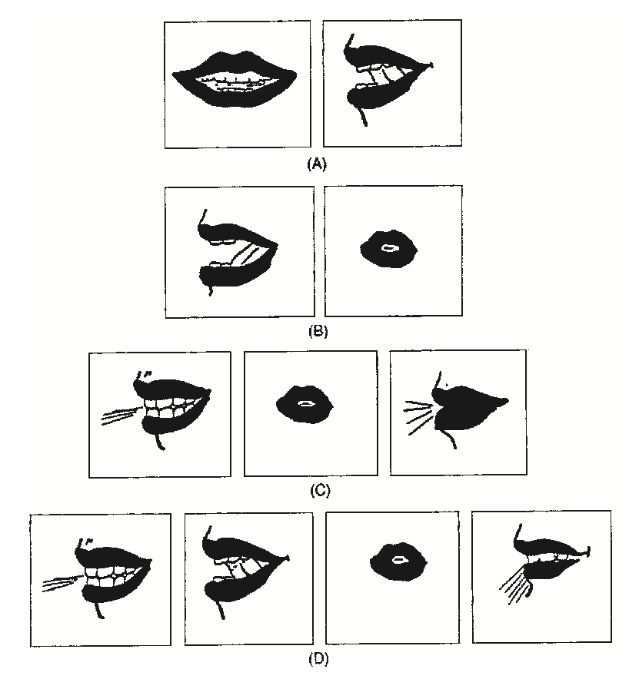
motivation: Morais et al. (1979); Read et al. (1986)

---

objection

‘some individuals can learn to do this task without alphabetic literacy.’
(Read et al., 1986, p. 39) [actually just one iirc, but still]

‘Czech and English children reliably isolated phonemes for which they did not know the corresponding letter’
(Hulme et al., 2005, p. B1)

insert-transcript#e88347a4-460f-4a1c-ae04-9ccb1830c5d5-here

Castiglioni-Spalten & Ehri (2003, p. fig.~1)

insert-transcript#7b72e8a1-3d40-4ae7-b099-4780c8bf2132-here

so far:

phone-structured motor representations not sufficient but can facilitate performance in phonological tasks

alphabetic literacy not necessary, but does predict ability

‘basic action concepts are demonstrative concepts.

To have the concept of a basic action is to have a concept of acting ‘thus’,

where ‘thus’ denotes a property made accessible to the agent by the motor representations he is able to form.’

(Pacherie, 2000, p. 425)

insert-transcript#99682b3d-1064-4c9c-9461-9c7efb6b5732-here

In the case of speech, what do motor representations make accessible?

sounds ≠ phonetic features (nor articulatory gestures)

‘the experimental task simply required our subjects to manipulate different sounds without regard for meaning.’

(Morais et al., 1979, p. 323 footnote 1)

participants ‘were asked to repeat it without the initial sound.’

(Chafouleas et al., 1997, p. 340)

‘I am going to say a word and I want you to tell me just the FIRST sound of that word.’

(Hulme et al., 2005)

‘while omitting its first, second, penultimate, or last sound.’

(Veenendaal, Groen, & Verhoeven, 2016, p. 58)

insert-transcript#2f2d665a-8eaa-4bd2-8f84-f4498208ddc2-here

How do researchers themselves describe
phonological awareness?

‘Phonological awareness refers to one’s degree of sensitivity to the sound structure of oral language.’

‘phonemes do not have physical reality independent of each other. That is, phonemes produced in speech are acoustically inseparable because adjacent phonemes are coarticulated.’

(Anthony & Francis, 2005)

(Anthony & Francis, 2005)

insert-transcript#eb451d74-e424-425b-9963-f5e87cfd508c-here

‘the segmentation of the acoustic signal does not correspond directly or in any easily determined way to the segmentation at the phonemic level ...

There is ... no acoustic criterion by which one can segment the sound into its constituent phonemes.’

(I. Y. Liberman et al., 1974, pp. 203–4)

insert-transcript#256e4777-1940-4a15-8078-df53082d6a3c-here

so far:

motor representations not necesary but can facilitate performance in phonological tasks

alphabetic literacy not necessary but does predict phonological awareness

‘basic action concepts are demonstrative concepts.

To have the concept of a basic action is to have a concept of acting ‘thus’,

where ‘thus’ denotes a property made accessible to the agent by the motor representations he is able to form.’

(Pacherie, 2000, p. 425)

insert-transcript#33b0861f-930c-4d9f-89f3-3f78451d4ba9-here

inspiration : tones and keypresses

learn keypress-tone association ;
later: hearing tone influences which key is pressed

‘one does not need to anticipate all effects of an action to recruit the corresponding movement.’

(Elsner & Hommel, 2001, p. 230)

insert-transcript#502b1ee0-9267-4f41-83c6-0c7c9a1512d8-here
Tones, keypresses and markersTop: in an acquisition phase, a left keypress produces a low tone and a right keypress a high tone; the tones are described to participants as irrelevant. Middle: at test, hearing the high tone primes the right key. Bottom, by analogy: an intention specifies a marker in experience; phone-related motor representations shape that marker; perhaps the marker activates the motor representation.left keylow toneproducesright keyhigh tonetones describedas irrelevanthigh toneright keyprimesintention(‘thus’)marker inexperiencephone-relatedmotor representationspecifiesshapesactivates?

findings: (Elsner & Hommel, 2001); on the link to interfaces: Liu (2026)

insert-transcript#159cedee-ad40-4c69-8e27-bd37b2e00cf3-here

clue: better reading is linked to less coarticulation

(Popescu & Noiray, 2022; Cychosz, Munson, & Edwards, 2021; Cychosz, Munson, Newman, & Edwards, 2021)


insert-transcript#4c18f16e-87a5-4ab6-bcf3-b8d5f610928c-here
Experience-backed demonstrative conceptsAn indirect proposed route to matching: phone-related motor representations influence experience, which yields discriminating markers. Attending to markers, sometimes aided by letters or mouth pictures, enables acquisition of demonstrative concepts later used in intentions. A red break indicates failure of inferential integration; a dashed white arrow indicates possible feedback from literacy to motor structure. This explains matching, not motor-plan selection.intentionphone-related motorrepresentationsinfluencesexperienceyieldsmarkers discriminatemotor outcomesattend tomarkersletters / mouth pictureshelpdemonstrativeconceptlater useexecutable actionconcept link
insert-transcript#2d9cdbec-5c00-46e9-89b1-430e85206671-here

observational vs executable action concept
(Pacherie, 2011, p. §3)

executable action concepts are linked to motor schemas
(Mylopoulos & Pacherie, 2016, p. §5)

deployment ‘serves as a pointer to a where appropriate motor schemas ... are stored’
(Mylopoulos, 2022, p. 288)

concepts are pointers
(Shea, 2024)

structured action representations
(Pacherie & Mylopoulos, 2021, p. §§4–6)

dilemma

is the concept’s content fixed independently of the motor schema it points to?

if yes:
how do they every non-accidentally match?

if no:
looks like deference again (?)

compare: Shepherd (2019); Levy (2025, p. §2.3); Ferretti & Caiani (2019, p. §3)

insert-transcript#60657fa9-44f2-4efb-9266-f4fbcb9eb3aa-here

some executable action concepts are
demonstrative action concepts
which exploit the ideomotor principle

insert-transcript#08804f9c-bb1c-4162-819a-a4db57e42750-here

CONCLUSION

Some Interface Problems are genuine problems;
we do not yet know how to solve them all—

but expeirence and demonstrative action concepts
are likely to matter.

insert-transcript#9583baf9-37a4-46e6-85cd-2f43888b2fc3-here

appendix

insert-transcript#26b11346-a387-4f9e-bf2e-4d8a811a689a-here
INTENTIONyesno
Is it a mental state?Davidson (1978)Thompson (2008)
Is it a belief?Velleman (1989)Bratman (1987)
Entails belief?Harman (1976)Levy (2018)
Linked to planning?(Bratman, 1985)
Incompatible with habitual? Kalis & Ometto (2021)
Entails non-observational knowledgeAnscombe (1957)
Comes in two kinds?Searle (1983)Brozzo (2021)
insert-transcript#dc270b5a-fa82-4736-8654-aaca4c994f36-here

Misfire Objection

‘unclear what it would be for such a demonstrative to misfire’

Mylopoulos & Pacherie (2016, p. §4)

reply: those who say ‘ox’ has two phones, [ɒ] and [ks], are deferring to a letter falsely believing that they are demonstrating a single phone.

insert-transcript#7d0b641e-b636-41c4-8bad-ab76782a88c5-here
A misfiring demonstrative: ‘ox’The letters o and x; the phones [ɒ], [k] and [s]. The letter o corresponds to [ɒ]; the letter x corresponds to two phones, [k] and [s]. A demonstrative, that sound, defers to the letter x and so picks out [k] and [s] together: a misfire in which two phones are taken for one.lettersphonesox[ɒ][k][s]‘that sound’defers tomisfire: two phones taken for one

(Treiman & Cassar, 1997)

insert-transcript#23f1575f-b1e0-4885-9d31-ec66e5c33f2f-here

Selection Objection

Lack of Example Objection

Awareness Objection