Keyboard Shortcuts?f

×
  • →Next step
  • ←Previous step
  • ↓Skip this slide
  • ↑Previous slide
  • mShow slide thumbnails
  • tShow transcript (+SHIFT = all transcript)
  • nShow notes (+SHIFT = all notes)

Please be cautious in using the transcripts.

They were created mechanically and have mostly not been checked or revised.

Here is how they were created:

  1. live lecture recorded;
  2. machine transcription of live recording;
  3. ask LLM to clean up transcript, and link to individual slides.

This is an error-prone process.

Click here and press the right key for the next slide.

(This may not work on mobile or ipad. You can try using chrome or firefox, but even that may fail. Sorry.)

also ...

Press the left key to go backwards (or swipe right)

Press n to toggle whether notes are shown (or add '?notes' to the url before the #)

Press m or double tap to slide thumbnails (menu)

Press ? at any time to show the keyboard shortcuts


The Question

https://t.ly/x_zgk


Unknown Minds, Shared Norms

confident local agreement

+

variation between groups and experts

for

- agency attributions

- mental state attributions

How to explain both agreement and variation?

My starting point is the observation that you and I are often very confident in making mental state attributions. We often agree with others around us on what someone thinks or intends, and we sometimes even regard disagreement as something approaching a normative matter.
For this, I don't have evidence; I will just appeal to informal observation.

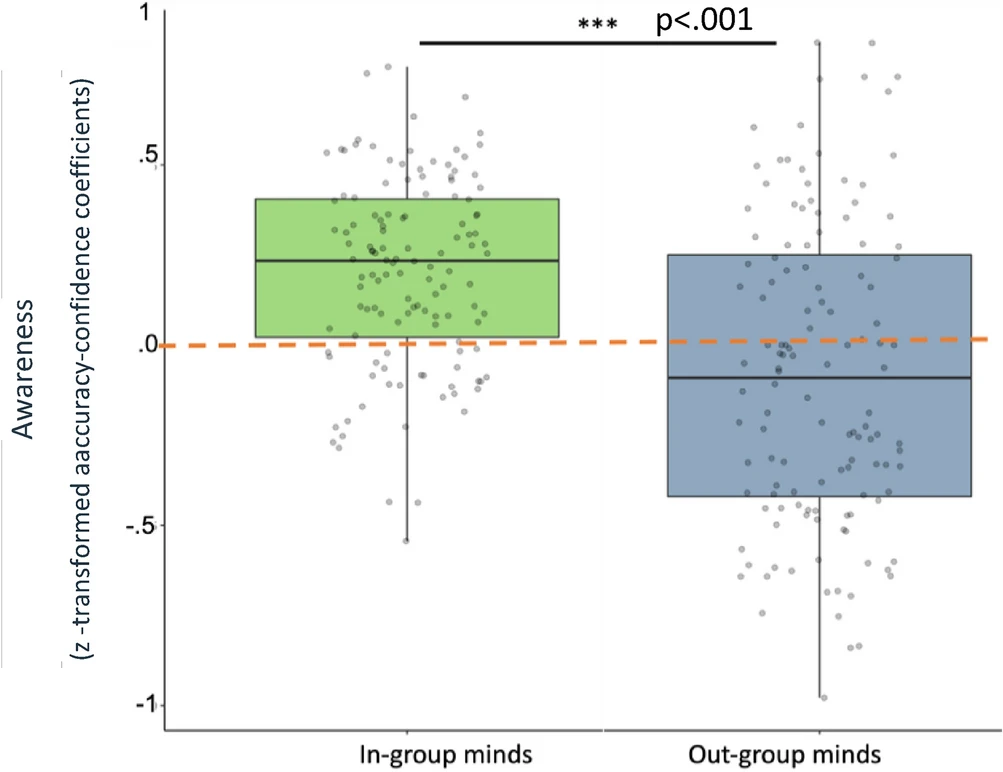
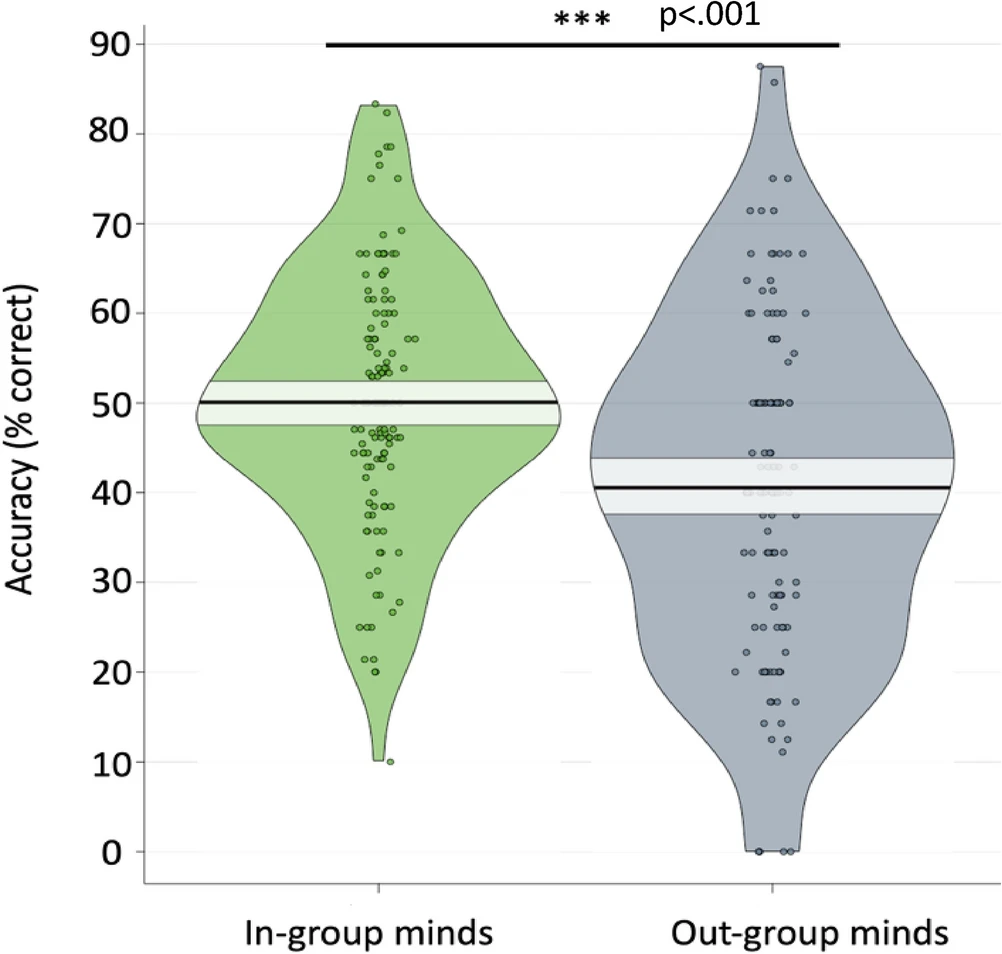
Payne, Bird, & Catmur (2025, p. Figure 1)

These are results of Experiment 1 (I didn't use Experiment 2 because they have a strange feedback manipulation that fucks up the chance baseline so it looks like they have improved performance but that might just be an artifact of feedback—could not figure it out although iirc they claim improvement ∞todo: check)
In 'no feedback', chance is 20% (score = 1 only if the predicted 1-5 rating matches the actual rating; 0 for any other prediction). So it's quite a hard task.
‘participants were presented with a target-mind’s response to an initial ‘start- ing’ statement. For instance: ‘Participant 437 [the target- mind] said that they strongly disagree that they believe in the superiority of their own gender’. Based on this infor- mation about one of their mental states, participants were asked to predict the target-mind’s response to a second tar- get statement on a scale of 1–5, whereby 1 denoted ‘strongly disagreed’ and 5 denoted ‘strongly agreed’. For instance, participants were asked whether they thought Participant 437 thought that ‘We should ensure that no one is denied a job due to prejudice’.’ (Payne et al., 2025, p. 2061)
in- vs out-group = closer or further away on the answers to the starting statement items. (closer = 0-1 scale points)
Payne et al. (2025) show (i) better performance for in-group that out-group members;
(ii) feedback helps in both cases
(iii) confidence scores are unrelated to accuracy for out-group members before feedback, indicating no awareness of when they are right and when they are wrong.

Payne et al. (2025, p. Figure 1)

Payne et al. (2025, p. Figure 1)

Notably they have no idea of their own accuracy for out-group members (in the sense that their accuracy is unrelated to their confidence).

Payne et al. (2025, p. Figure 1)

This is included just so nothing is hidden. Do not discuss.
The feedback design is a bit odd.
In the feedback condition, chance performance is 'who knows' but probably higher than 20%.
In the feedback condition, Participants revisit eight trials on which they had previously been wrong—four in-group and four out-group—and are explicitly told both that they were wrong and the correct answer. They are then given 8 previous items, 4 where they gave the correct answer and 4 where they gave the wrong answer. So if they just stick to their previous answers, they get 50%
Task was: given information about a particular survey respondent’s answer to one question, predict their answer to a different question.
Even ignoring the different baselines, there is no evidence of improvement from feedback. (But you do not want to emphasize that.)

confident local agreement

+

variation between groups and experts

for

- agency attributions

- mental state attributions

How to explain both agreement and variation?
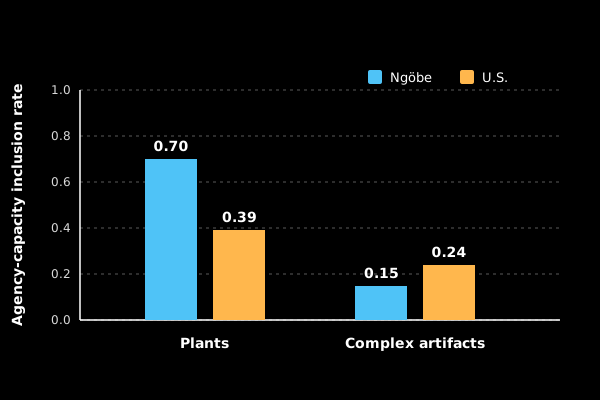
Stress that it’s not just people being broader or narrower in their attributions.
[use Strange Agents] Ethnographers describe a range of contemporary views concerning individual and shared agency. Among the Northern Ojibwa, % stones that merely move are not attributed agency, but certain stones are regarded as acting voluntarily and may even talk (Hallowell, 2019), and some guides in the Alps regard mountains as living communicators who send signals the guides learn to understand (Chamel, 2023). % also: ‘it’s horrible because the mountain is suffering a lot’ (Chamel, 2023, p. 245). Improvising musicians in the Netherlands report that music gains a life of its own, and becomes something that provides direction and requires service.[^obey-the-music] Of the things that to me seem to be inanimate objects and nothing more, some are regarded by *donso* hunters in Burkina Faso as agents. These *jo* can act in the world. If correct procedures are followed and appropriate moral conditions met, they may respond to human actions (Ferrarini, 2025, p. 235). Indeed, Ferrarini reports not merely using a *jo* as a tool but cooperating with it (Ferrarini, 2025, p. 235), and interprets sacrifice as sharing the results of a successful hunt (Ferrarini, 2025, p. 239). Or, to take another example, certain plants appear to Makushi people in Guyana as helpers to be called on. When approached in the right way, these special plants can become voluntary partners in actions such as diagnosis and healing (Whitaker, Tamboli, Daly, & Lewy, 2024, p. 353). And for a Pemon *kanaima* in Venezuela, a plant may be regarded as the dominant partner in a relationship (Whitaker et al., 2024, p. 355).

ojalehto, Medin, & García (2017) drawn from Experiment 2 (part)
NOT A FIGURE FROM THEIR PAPER!
This illustrates that neither group is simply more generous.
agency-inclusion rate combines rankings for entities across capacities. It's the average proportion of entity × capacity judgments in which the entity was treated as having at least some of the relevant capacity.
In Exp 2: six agency capacities: cognition: communication, memory, morality experience: fear, pain, hunger
plant category includes two plants; complex artefacts combines robot and computer.
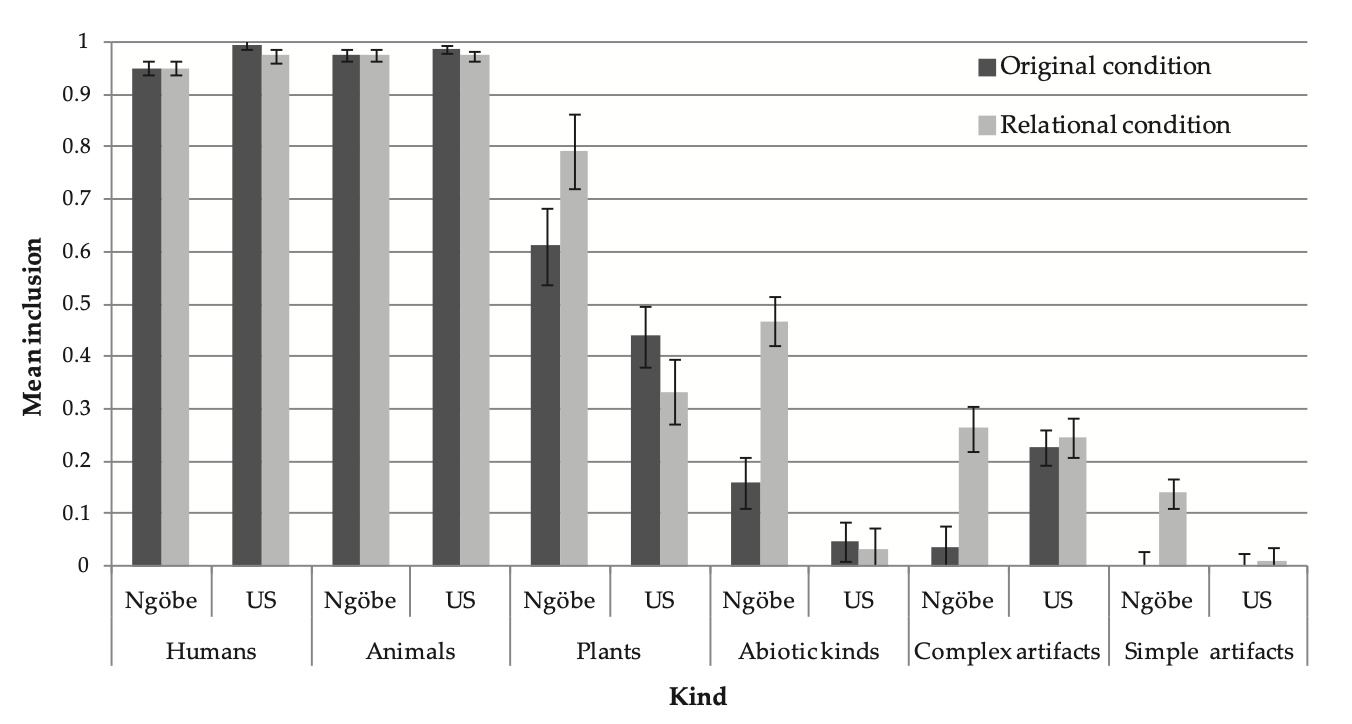
The true picture is a bit more complicated ...

ojalehto et al. (2017) redrawn from Figure 1 (part)

If you make the attributions relational (shift from whether it can feel to whether it can feel pain,say), then the pattern is a bit different; roughly, the Ngobe attributions increase in most cases.
But the overall picture I just offered is roughly right.

confident local agreement

+

variation between groups and experts

for

- agency attributions

- mental state attributions

How to explain both agreement and variation?
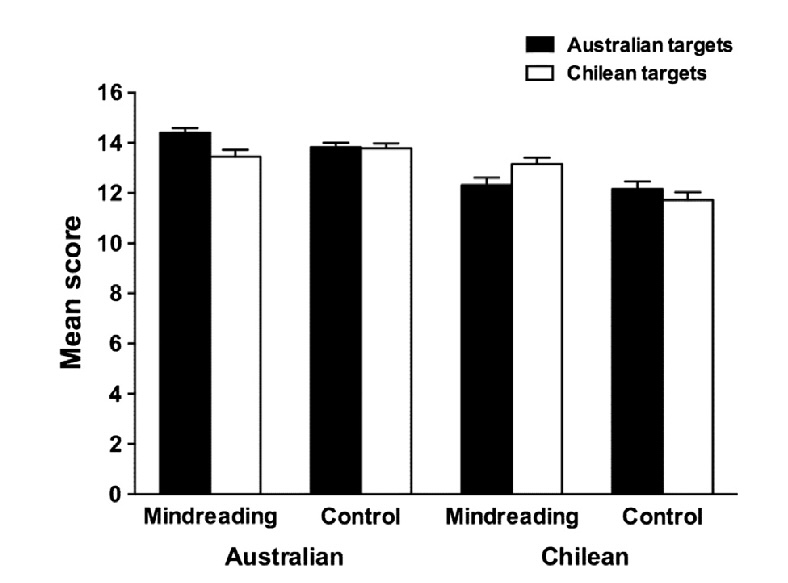
Perez-Zapata, Slaughter, & Henry (2016, p. Figure 3)

Perez-Zapata et al. (2016) gave Australian and Chilean adults two sets of ‘strange stories’ mindreading tasks (Happé, 1994; White, Hill, Happé, & Frith, 2009). One set was adapted to Chilean cultural context (names, places, pictures were changed) while keeping the mindreading demands as similiar as possible. They found an interaction: each group of participants did slightly better on the strange stories adapted to their cultural group.
Control shows that, in non-mindreading, the cultural adaptation does not affect performance.

Mitchell, Teucher, Kikuno, & Bennett (2010, p. Figure 3a)

Mitchell et al. (2010) asked children in Britain and Japan how much they knew about their own feelings and mental states (feeling happy or thinking, for example) and how much a parent or teacher know. They find that Japanese children overall attribute less first-person authority than British children (adults know relatively more in their estimation).

Mitchell et al. (2010, p. Figure 3b-c)

For completeness (works against my argument so should mention it): Mitchell et al. (2010) also studied two other age groups, and did not find the same patterns there.

there are also expertise effects ...

Starmans & Friedman (2020, p. Figure 3)
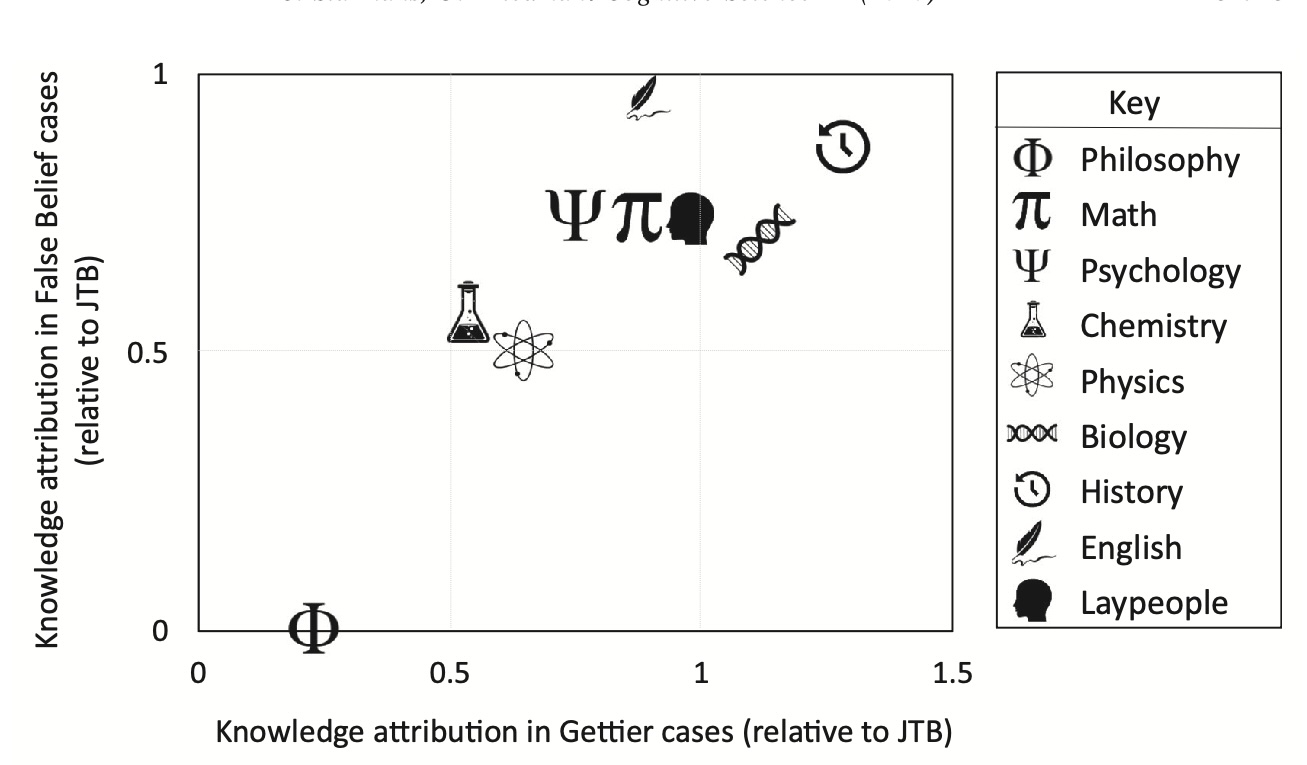
?? Personal anecdote about reviewing Starmans & Friedman (2012), not believing it and demanding an control explanation, and over time ending up totally persuaded they are right.

Starmans & Friedman (2020, p. Figure 2)

∞todo there’s more research that I need to review; see `k8Qp3Vr7Lm2Nx5Ht9Ds4Aw.md`; more recent research does not contradict these findings.

confident local agreement

+

variation between groups and experts

for

- agency attributions

- mental state attributions

How to explain both agreement and variation?