
Please be cautious in using the transcripts.
They were created mechanically and have mostly not been checked or revised.
Here is how they were created:
This is an error-prone process.
Click here and press the right key for the next slide.
(This may not work on mobile or ipad. You can try using chrome or firefox, but even that may fail. Sorry.)
also ...
Press the left key to go backwards (or swipe right)
Press n to toggle whether notes are shown (or add '?notes' to the url before the #)
Press m or double tap to slide thumbnails (menu)
Press ? at any time to show the keyboard shortcuts

?
model 1 = correct attributions + noise

... but expert disagreement!

Which things manifest agency?
‘The paramecium’s swimming through the beating of its cilia, in a coordinated way, and perhaps its initial reversal of direction, count as agency.’
(Burge, 2009, p. 259)
‘the paramecium cannot be an agent [...]
None of its interactions with the environment [...] need involve anything like an act on the part of the paramecium.’
(Steward, 2009, p. 227)
plants are not agents
plants are agents

| INTENTION | yes | no |
| Is it a mental state? | Davidson (1978) | Thompson (2008) |
| Is it a belief? | Velleman (1989) | Bratman (1987) |
| Entails belief? | Harman (1976) | Levy (2018) |
| Linked to planning? | (Bratman, 1985) | |
| Incompatible with habitual? | Kalis & Ometto (2021) | |
| Entails non-observational knowledge | Anscombe (1957) | |
| Comes in two kinds? | Searle (1983) | Brozzo (2021) |

| KNOWLEDGE | yes | no |
| Is it a mental state? | Williamson (2000) | Hyman (1999) |
| Knowing entails believing? | Rose & Schaffer (2013) | Radford (1966) |
| Is it a form of belief? | Sosa (2007) | Williamson (2000) |
| Valuable for action? | Plato’s Meno | Kaplan (1985) |
| Is humanly attainable? | [lots] | Unger (1975) |
| Depends on context? | Lewis (1996) | [lots] |

obstacles
- many incompatible theories, each only slightly different from nearby alterantives
- differences hard to operationalize
- unclear when conflicting theories vs compatible theories of different things

no?
model 1 = correct attributions + noise

?
model 2 ≈ categorical perception
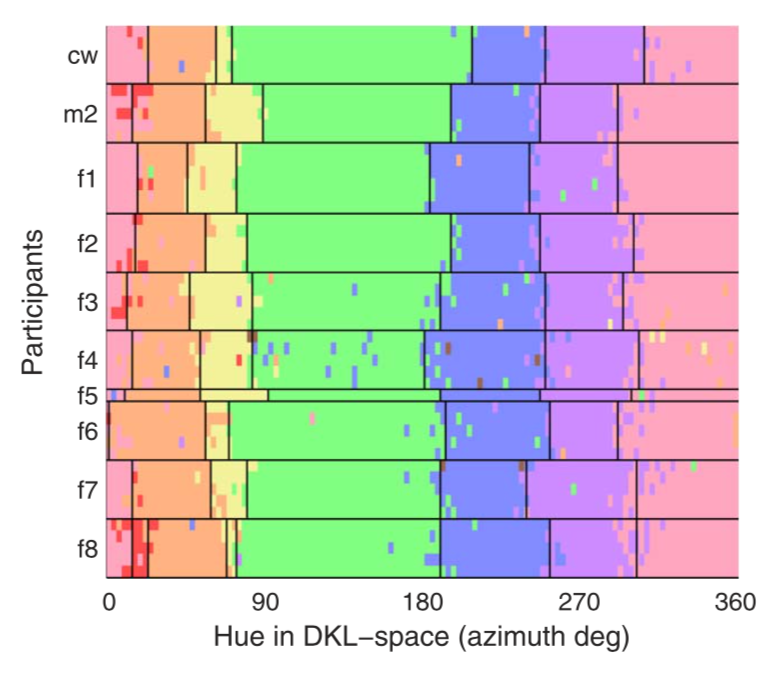
∞todo: categorical colours as a model
individual differences Witzel & Gegenfurtner (2018)
Berinmo vs Himba
there are constraints, but they are abstract (yes: categories probably mostly contiguous in similarity spaces; not: determined by unique hues (although unique hues play some role))
colour case has two uses:
1. we approach it without knowing what the true categories are, or even whether there are any (and I think we need the same for mindreading)
2. [use later, after MAC—supress for now] shows that we need standards (analogy: categories); does not show that any kind of norm is involved
see fT8Qa5Mn2Vx7Lp4Rs9KcHw.md

Witzel & Gegenfurtner, 2013 figure 6
English
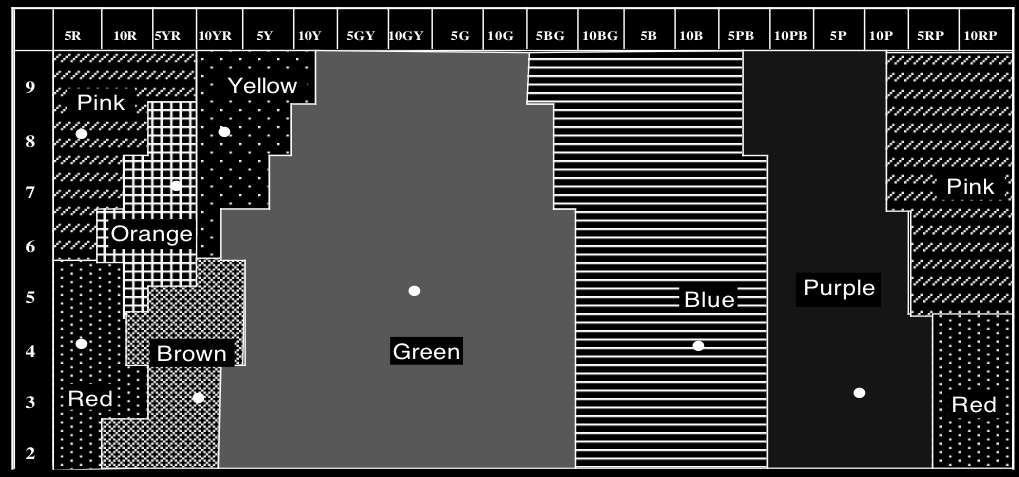
Roberson & Hanley (2010, p. Figure 1c)
Berinmo
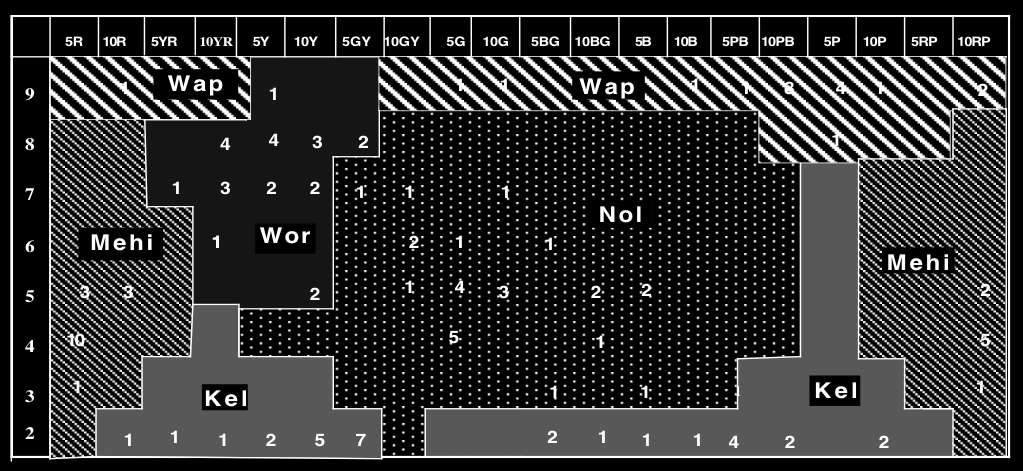
Roberson & Hanley (2010, p. Figure 1b)
confident local agreement
+
variation between groups
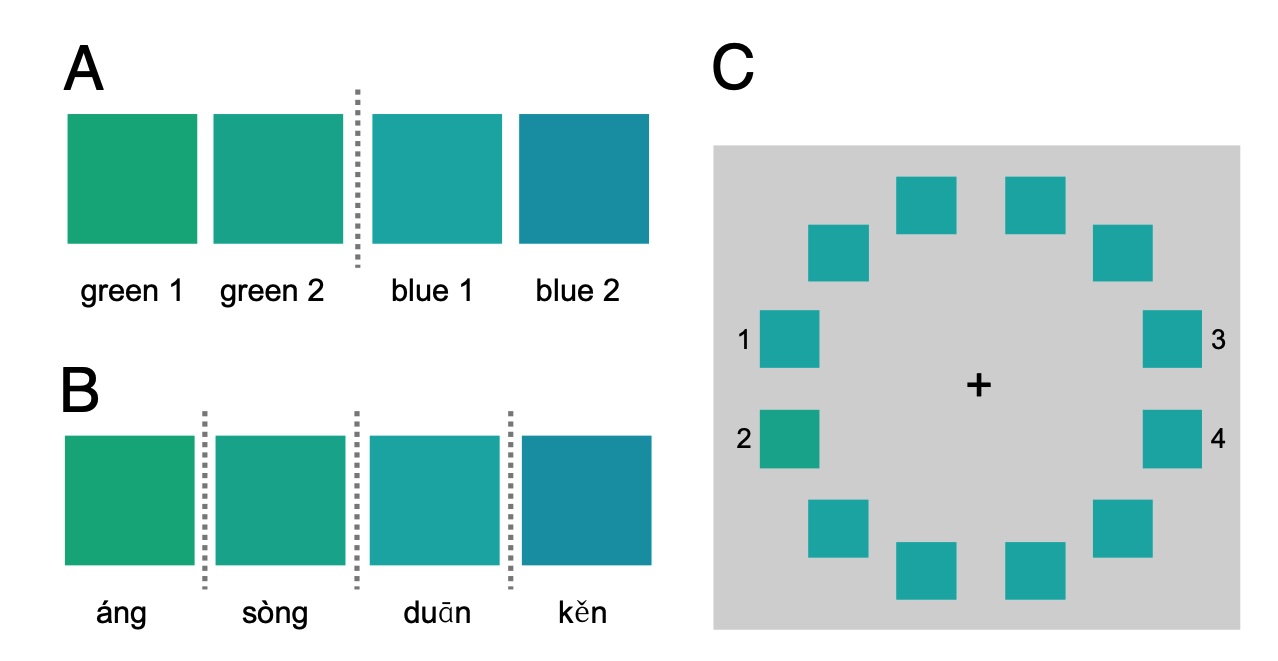
How to explain both agreement and variation?
- need to ask where background assumptions come from
background assumptions ≈ category boundaries

Zhou et al. (2010, p. Figure 1)
4-6 months : ~5 categories
Skelton, Catchpole, Abbott, Bosten, & Franklin (2017)
~1-3 years : ‘slow mapping’ of colour words
Wagner, Dobkins, & Barner (2013)
adult categories acquired over years,
influenced by language and culture,
differ from infant categories
Maule, Skelton, & Franklin (2023)